
Cincinnati apartments tend to break the standard moving advice. The OTR walk-ups have steep stairs and tight landings; the Hyde Park brownstones have gorgeous original wood floors you'd rather not gouge with a U-Haul dolly; the Mt. Adams hillside flats can require parking three blocks away. Cardboard makes all of these worse. Reusable bins make all of them faster.
What follows is the actual sequence we recommend if you want a one-bedroom packed in a single evening. It assumes you've got Settled bins delivered the night before — which means you skipped tape, assembly, and the grocery-store cardboard hunt entirely. The plan works for a studio or one-bedroom; two-bedroom and up, plan two evenings.
Before the bins arrive
Two days before delivery, do three things and only three things. First, open every drawer and cabinet and pull anything you haven't touched in a year. That goes in a giveaway pile by the front door — we'll have you load it into the bin closest to the door first so you can drop it at Goodwill on the way out. Second, eat down the fridge. We're not loading half-jars of mustard. Third, label one bin in your head as the open-first bin: chargers, the WiFi router, toiletries, the bedding for tonight's sleep at the new place. Don't skip this; it's the difference between collapsing into bed and standing in your kitchen at midnight wondering where your toothbrush went.
On delivery day (the night before pack night), park your bins exactly where you'll be using them. We'll stage them in your living room or hallway by default — tell us which. If you're in a tight Mt. Adams flat, ask for a smaller stack you can step around.
5:30 PM — start with the kitchen
The kitchen takes the longest, so start there while you have the most energy. Pull everything out of the cabinets and onto the counter. Wrap glasses with kitchen towels you'll need to pack anyway (free padding, fewer trips). Plates stack on edge inside a Settled bin, not flat — we know it sounds wrong, but the lateral force is what protects them. Sanitized bins mean you don't have to wash anything you're putting back in.
Pots and pans nest into a single bin with their lids stacked separately along one side. Knives stay in the block; tape the block shut. Spices and oils ride in a separate bin lined with a kitchen towel — if anything spills it spills there, not on a wedding-gift cookbook. Open boxes (cereal, pasta) go in their own bin; close them with a clip and lay them flat. Anything you might want in the next 48 hours — coffee, kettle, two mugs, a small pan — goes in the open-first bin you already labeled.
6:30 PM — bedroom
Skip folding. Open dresser drawers, lift the entire drawer out (most pull free), and slide it into a bin. Or just rotate the drawer 90° and tape the top — your call. Closet clothes go on hangers, in a wardrobe bin if you reserved one, or in a bin with the hangers still in. The goal is to never re-fold anything you'll re-hang in 24 hours. Shoes go in their own bin in pairs, soles down. A Cincinnati basement closet often has more shoes than the rest of the apartment combined; budget two bins.
Bed: strip the sheets, pack them in the bin holding tonight's pillows and the blanket, and label that bin clearly. Mattress and box spring don't go in bins (obviously) but if you have a Hyde Park or Oakley single-family with a tight stairwell, a mattress bag is worth the $10. Same goes for the OTR walk-ups — narrow stair turns ruin un-bagged mattresses.
7:30 PM — bathroom + miscellaneous
Bathroom is fast: under-sink stuff, medicine cabinet, towels, shower curtain, the trash can you'll need at the new place. One bin holds the entire room. Same for the linen closet. The miscellaneous bin is the most important one — label it clearly, pack the chargers, the WiFi router, the trash bags, the bedding for tonight's sleep at the new place. This bin rides with you in the front seat of the rental truck. Don't lose it.
8:30 PM — books, art, frames
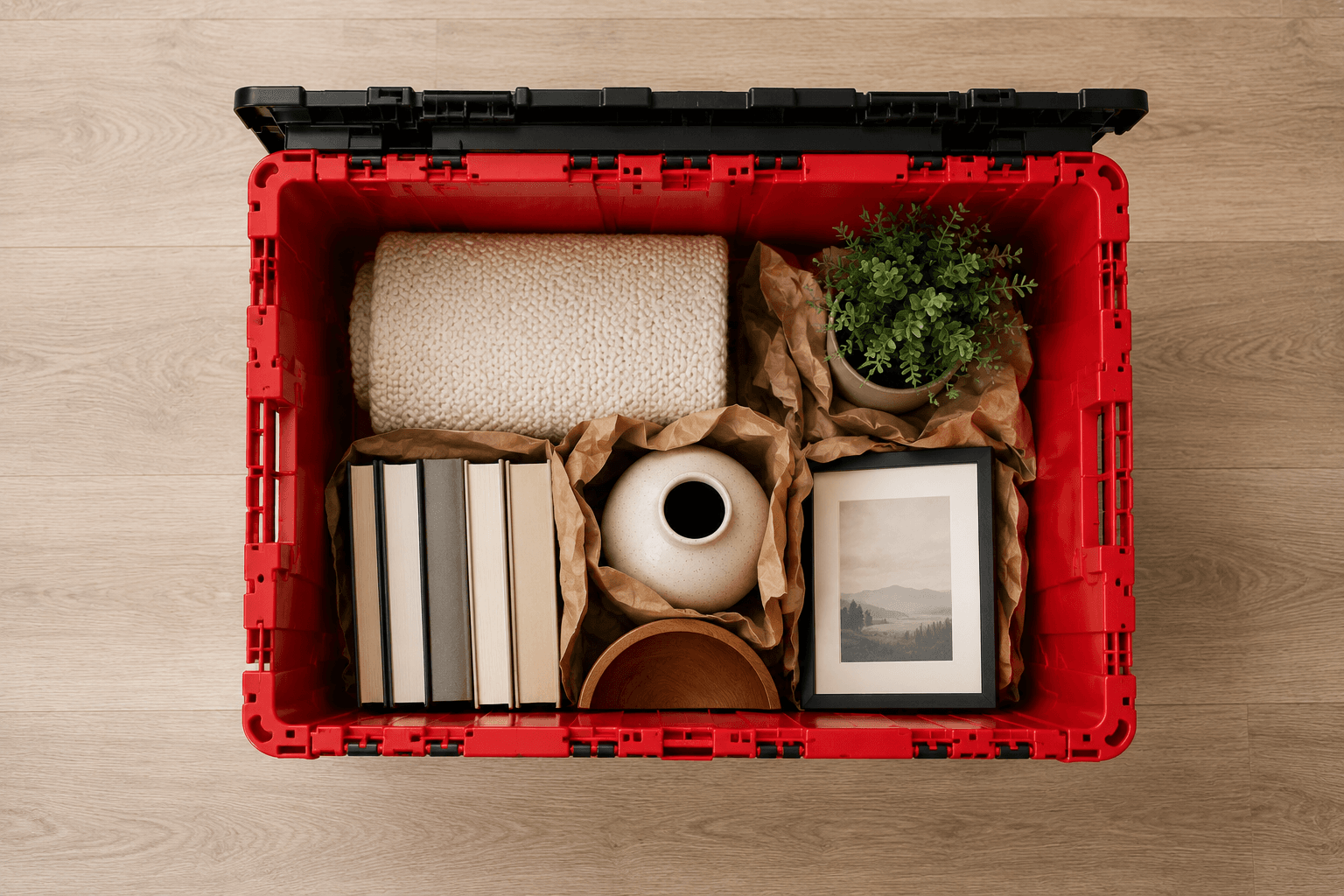
Books are heavier than they look — the 60 lb rated Settled bin handles a one-bedroom's library in 3-4 bins. Stack books spine-down or on their sides; never spine-up (the spines slowly tear under their own weight). Wrap framed art in towels or quilts, never with cardboard between them. Stack frames on edge against the side of the bin, not flat. If you have anything genuinely fragile — vintage glass, ceramics, a wedding heirloom — pack it last in a bin you'll carry yourself, with a sticky note on the lid that says 'do not stack' so the moving team knows to keep it on top.
9:30 PM — done. Mostly.
By 9:30 you should have ~15-20 bins packed, labeled, and stacked four-high in your living room on the dolly. The morning's job is just lift-and-load. That's the whole pitch — pack in evenings, not weekends.
Cincinnati neighborhood-specific notes
OTR / Pendleton / West End
Almost every move in the basin is a 4-flight walk-up. Reserve your delivery for the night before — morning street parking on Vine, Main, and Race is unforgiving and the loading zones fill by 8 AM. If your building has a freight elevator (some of the bigger conversions do), book it now; landlords give them out first-come. Bin stacks of three on a dolly handle the standard OTR stair geometry; four can scrape on tight landings.
Mt. Adams / Mt. Auburn
The hill streets confuse navigation apps and your moving help. We stage on the flatter cross-streets (Belvedere, Pavilion in Mt. Adams; Auburn Ave. in Mt. Auburn) and walk in. If you've got steep historic staircases between street and door — a real Mt. Adams thing — let us know at booking and we'll send the right team with smaller dollies. December through March, watch the weather forecast; an ice event closes these streets for hours.
Hyde Park / Oakley / Mt. Lookout
The plateau is the easiest place in Cincinnati to move. Most homes have driveways or alley access, off-street parking, and reasonable stair geometry. The thing to plan around: original hardwood floors. Use furniture sliders or felt pads; a Settled dolly's casters are floor-safe but anything you carry in a hurry isn't. Hyde Park brownstones often have side service doors that are easier than the front; ask the landlord which is best.
Northside / Clifton / Walnut Hills
Mostly older multi-family. Stairs are usually fine but landings can be tight. Clifton's UC adjacency means the last week of August is chaos — book your delivery window 10 days out if you're moving the weekend before classes start. Northside parking is the easiest of the three; Walnut Hills the hardest (Peebles Corner is dense, plan for street parking and a dolly walk-in).
Mason / West Chester / Anderson
Suburban moves are the easiest of all. Driveway-to-driveway, garage-to-garage. Most homes have plenty of room for a 26-foot truck and a stack of bins on a wheeled dolly. The thing to plan: HOAs sometimes restrict moving truck parking. Ask the listing agent or your closing coordinator about restrictions before delivery day — we've seen Mason HOAs require trucks be off the street by 7 PM.
Common Cincinnati packing mistakes we see
- Overloading the kitchen bin with cast iron (use two bins; cast iron + glassware in the same bin is how plates break).
- Forgetting that hill-neighborhood movers need extra time on stairs (Mt. Adams: budget +30 min versus Hyde Park).
- Not labeling bins by room (saves zero time packing, costs hours unpacking).
- Packing the open-first bin and then loading it deep in the truck (always last in, first out).
- Skipping the giveaway pass two days before — you'll move stuff you'd have donated, and it's just dollies and dollies of regret on the other side.
Cincinnati is one of the more pleasant cities in the country to move into, on the whole — affordable, varied housing stock, real neighborhoods, and a moving-day weather window that's usually generous. The Settled playbook just removes the boring parts. Pack on a Tuesday night. Wake up Wednesday and load. Sleep in your new place by Wednesday night.