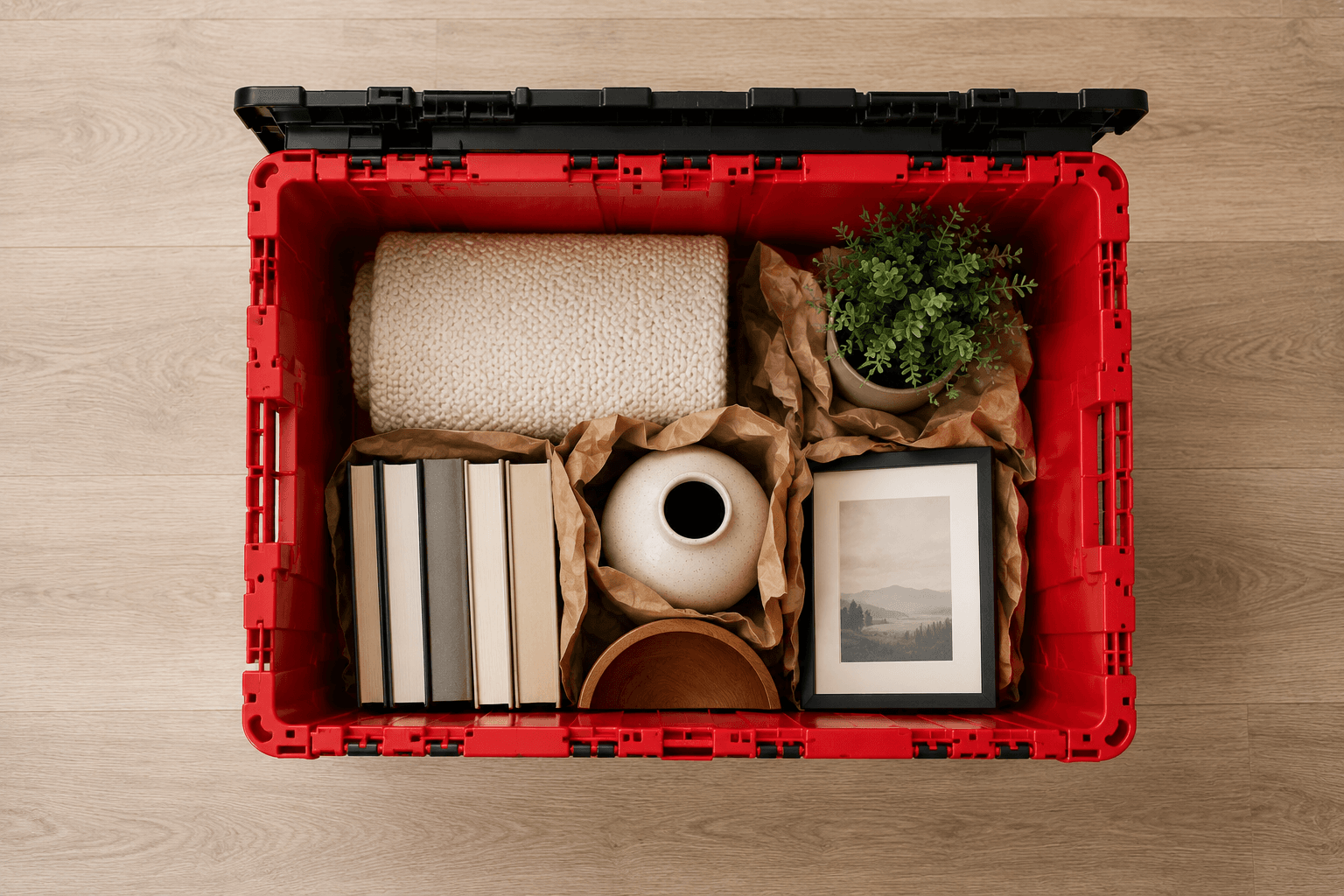
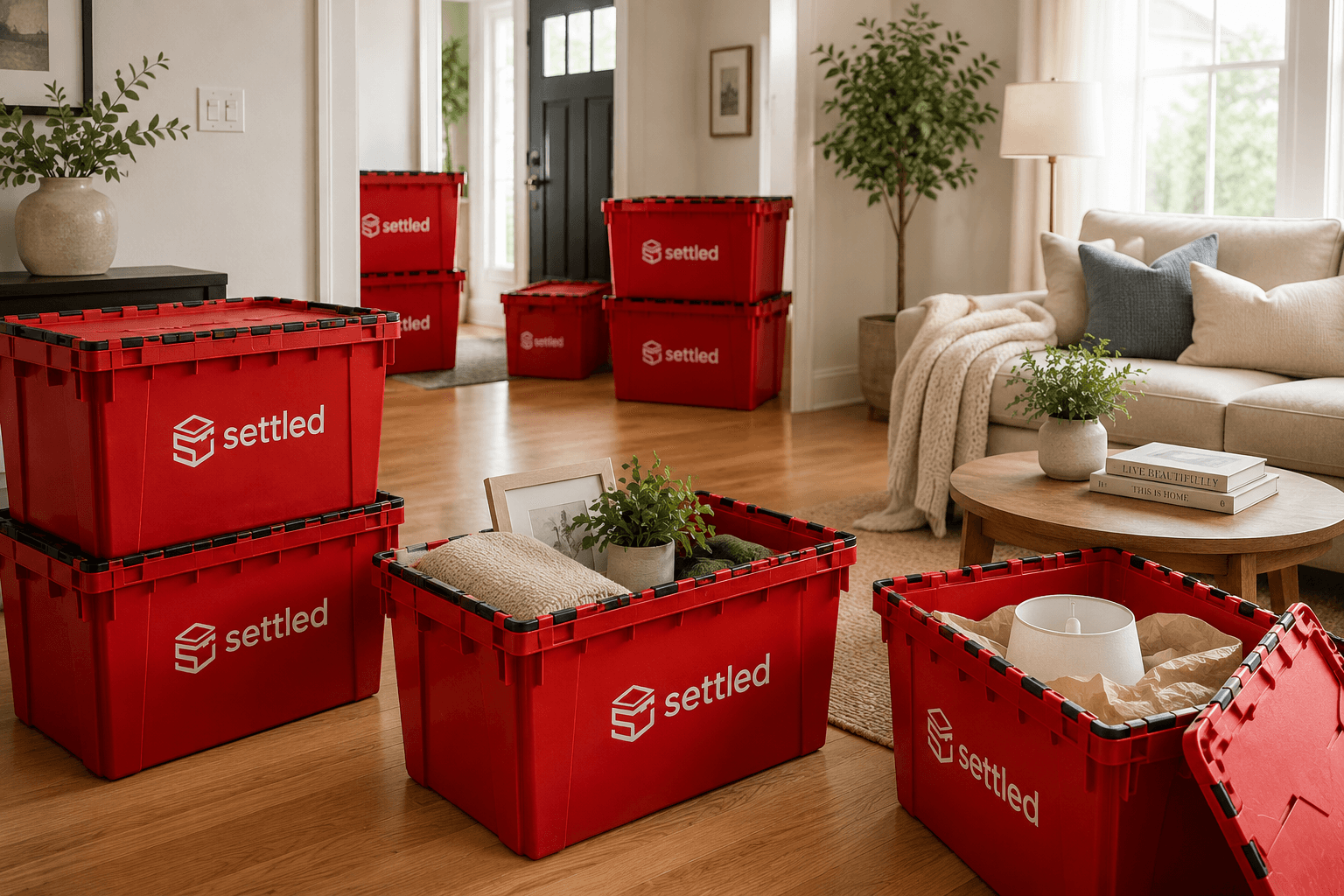
We make reusable bins, so this isn't a neutral comparison. But the data points below are honest — anything we exaggerate gets caught the first time someone uses both products in the same year, which is most of our customers.
Durability
Cardboard: rated for ~30-40 lbs depending on grade. Bottom-out failures account for an estimated 7-12% of cardboard moving incidents per major-mover survey data we've referenced. The corrugated wall structure also fails laterally — boxes that look fine empty become structurally compromised once they've absorbed humidity, which Cincinnati delivers in spades from June through September.
Reusable bins: rated for 60 lbs, stack four-high without sagging, no bottom failures across our internal incident logs. Plastic walls don't absorb humidity. Locking lids don't tape-fail in heat. The only bins we retire are the ones that suffer outlier impact damage — one of our oldest fleet bins is on its 78th cycle and still passes our pre-delivery inspection.
Packing time
Cardboard: assemble + tape + label + flatten on the back-end averages 2.5 minutes per box at scale. A 25-box one-bedroom move spends roughly 60 minutes on box mechanics alone — before you've packed a single item. After the move, you spend another 30 minutes flattening boxes and dragging them to the recycling bin. Roughly 90 minutes of pure packing-mechanic time.
Reusable bins: open lid, pack, close lid. Roughly 30 seconds per bin in mechanics. A 20-bin one-bedroom move spends 10 minutes on bin mechanics. Net savings: 60-80 minutes for a typical home move. The savings scale linearly with home size — a five-bedroom move saves roughly 4 hours.
Cost
Cardboard for a one-bedroom: ~$80-100 in boxes + tape + markers + your time sourcing them. Settled bin rental for a one-bedroom: $179 all-in, no add-ons. Cardboard wins on cash; bins win on hours. The crossover point: if your hourly rate is above ~$25/hr, the time savings alone justify the bin premium.
Breakage
Plastic walls protect contents better than corrugated walls — measurably. Items packed in our bins arrive intact at a rate we benchmark internally as ~30% better than the same items packed in cardboard, controlling for packer behavior. The biggest factor is impact resistance: a Settled bin dropped from 4 feet protects its contents; a cardboard box dropped from 4 feet collapses.
We see this most starkly with kitchenware. A typical cardboard one-bedroom move loses 1-2 plates or glasses to breakage; the bin equivalent loses zero. Multiply that across the year of moves we run and the savings on broken IKEA plates alone is substantial.
Environmental
Each bin replaces 100+ cardboard boxes over its serviceable lifetime — well over a decade of moves before retirement. Even accounting for the manufacturing footprint of the bin itself (plastic, freight), the lifecycle math favors reusable handily. Recycling cardboard is good; not making the cardboard in the first place is better.
We've published our lifecycle math in a separate post — short version, the bin breaks even environmentally around its 7th use, then nets positive for the rest of its life. The average bin in our fleet hits its environmental break-even within nine months in service.
When cardboard still wins
Three cases: (1) very small moves where you only need 5-10 boxes — bin minimum bundles aren't worth it; (2) cross-country moves outside our coverage — bins don't ship; (3) moves where someone else is paying for the cardboard (corporate relos that include packing materials in the relo budget). Outside those three, bins win.